


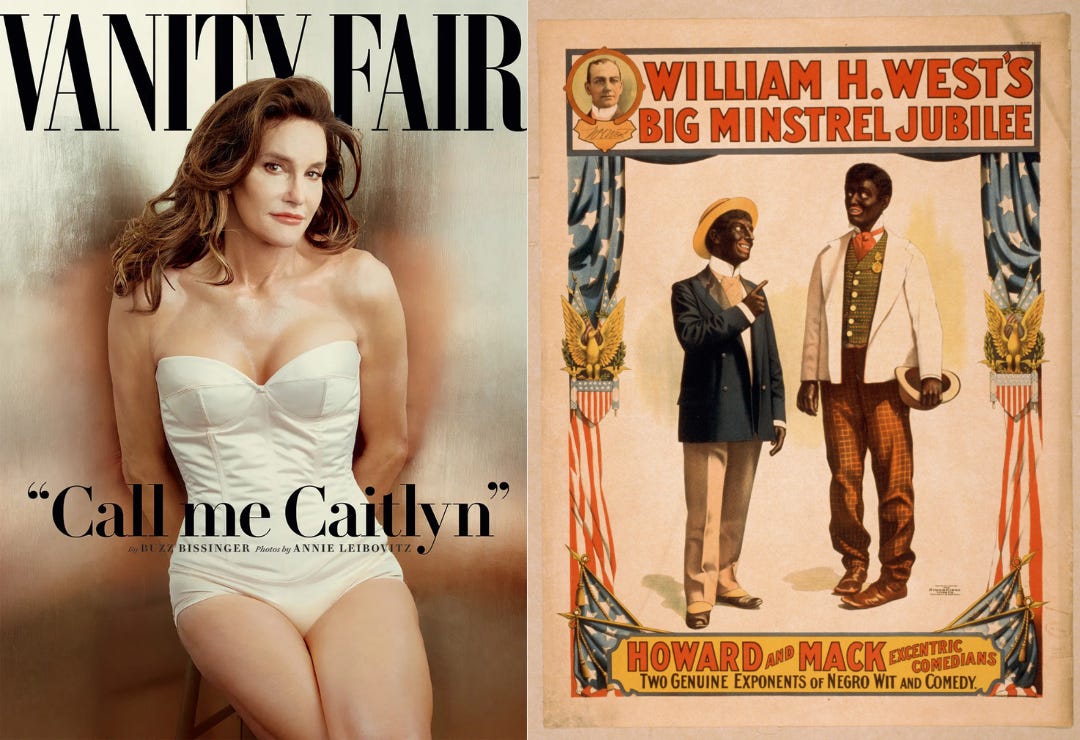
Within the past few years, I’ve noticed a lot of gender-critical feminists have used the term “womanface” to describe the behavior of transwomen: males who dress up and perform femininity as a caricature of women.
“Womanface” is intentionally used to liken transwomen’s behavior to the racist history of Blackface: a theatrical practice in which white actors paint their faces black as a precursor to act out damaging stereotypes of Afro-descended people for the entertainment of white audiences.
Although I intuitively understand the comparison, I have serious issues with the usage of “Womanface” in this context, which I will elaborate on here.
A Brief History of Blackface
Minstrel shows featuring Blackface were the first uniquely American form of theater. Minstrelsy initially gained popularity in the mid-19th century, and climaxed in its cultural prominence during the post-Civil War era, furthering racial divides after the abolition of slavery. Many scholars note that minstrel shows were used to justify violence and anti-black sentiment during Jim Crow segregation.
Blackface is most commonly associated with the U.S., but it also has some roots in European history, as seen in 19th century Netherlands with the emergence of Zwarte Piete, the Moorish companion of Saint Nicholas.
Although traditional minstrel theater has significantly declined in popularity, it has arguably revived itself in other forms, and Blackface still remains a key element in some European cultural performances, such as Spain’s Three King’s Parade.
As we can see, Blackface is a theatrical practice by people of European descent. Regardless if it takes place on stage, in a parade, in a movie, or as a Halloween costume—there is always some performative element that is intended to be recognized as a form of entertainment for its onlookers.
This lays the foundation for the false comparison between Transwomen and Blackface.
Trans Identity vs. Theatrical Performance
While you can reasonably say that transwomen are performing femininity, the main distinction is that transwomen have adopted this performance as a lifestyle.
And for many transwomen, it’s not just about what they wear—some have also sought cosmetic changes to their voice, body, name, and overall appearance in a genuine effort to realistically look female—not just to look like a caricature of a woman.
Although most transwomen do not “pass” as female regardless of their efforts—some do, at least to the average person—and as such, they move throughout their everyday lives superficially appearing as women until someone finds out, or until they reveal their male status.
The other thing is that some transwomen don’t care to look like women at all. They make zero effort to feminize their appearance, and their transgenderism is entirely identity based. Expressions of “transness” are highly individualized.
This is important to note, because stripped to its core—trans is not a set of behaviors, fashion choices, makeup colors, surgical procedures, or personality traits.
It is just an identity.
So, the split between Trans Identity vs. Blackface as a theatrical performance is vast.
Think of it this way:
Trans identity can include males who perform damaging female stereotypes purely for entertainment purposes—but it is not exclusive to that group in the way it is for Blackface. So it is not accurate to draw that comparison.

False Comparisons Never Age Well.
On a personal level, the main issue I have with “Womanface” is the fact that it is, yet again, another example of white people using black pain to add legitimacy and weight to their argument, even where it’s totally ill-fitting and inappropriate.
Writer Karen Zebrowski speaks about this in her recent essay, Black People Are Not Your Metaphor, where she mentions white folks who like to say that “cis” is a slur equivalent to the word “nigger”.
I would say that the “cis/nigger” comparison is far more heinous than “Womanface,” but they are both rooted in the same idea of various groups instrumentalizing the black struggle for their own political gain.
As much as I speak about trans activists employing this tactic to legitimize transgenderism, the reality is that white people from any side of the political spectrum will often do the same thing, whether they are conscious of it or not.
The black struggle is low-hanging fruit to add weight behind a political argument because for one, the Trans-Atlantic Slave Trade was particularly brutal, longstanding, and pervasive in its impact, but most importantly…we’re not that far away from it, even though folks love to selectively pretend that we are.
I mean, you can go on youtube and listen to audio recordings of former African-American slaves, for Christ sakes! The fact that we had such advanced technology to record these interviews, says everything. As a young filmmaker, I have also interviewed several activists who fought for civil rights during the Jim Crow era. These women are still alive and well to this day.
As much as people love to frame racist brutality as ancient history, it’s not…not even the indisputably painful eras that many people try to sweep under the rug as the past.
I will add that I believe there is a much stronger comparison between “Womanface” and Drag (men caricaturing women in performance). Many Drag Queens are men whose performance of womanhood is entirely relegated to the stage.
But even drag is somewhat questionable as a worthy comparison. When drag originated in the 1920s, it was (and still is) largely relegated to underground, adult-themed bars and gay culture—hence the recent outrage over bringing drag performers into children’s spaces.
Drag didn’t have the same cultural influence as Blackface because it wasn’t mainstream. For decades, Blackface was the most dominant form of entertainment for white audiences of all backgrounds in the United States, and it influenced our culture accordingly. The same cannot be said about drag.
The most accurate comparison of Transgenderism is still Transracialism, which is slowly becoming normalized through identity politics.
Honestly, I think reaching for emotionally-charged, yet false (and potentially offensive) comparisons through the black freedom struggle is really ineffective as a political strategy—especially in the long run.
The harm that trans-identifying males are doing to women doesn’t need to be punctuated with Blackface in order to make a statement.
It really should be able to speak for itself.
How Transracial Will Soon Be Totally Normal

When the words that we use to identify people, are reduced to mean essentially nothing-it opens the door for anyone to claim those identities for their own purposes, especially if there is an advantage to be had in doing so.
Good points here. Transgenderism as a lifestyle (of deluded men), vs blackface as a derogatory performance. The misogyny of trans can be compared to racism, but it’s definitely not an exact parallel. On the flip side, the pro-“trans rights” activists try to do this comparison with American past racist policies also. For example: “Not allowing trans women into women’s bathrooms is just like Jim Crow!” The progressive left screams. Ridiculous.
But isn't the comparison made with drag queen art as "womanface", and not transgenders in general?