In Defense of Light-Skinned Women
Black Women Who Bully Their Mixed-Race Sistren
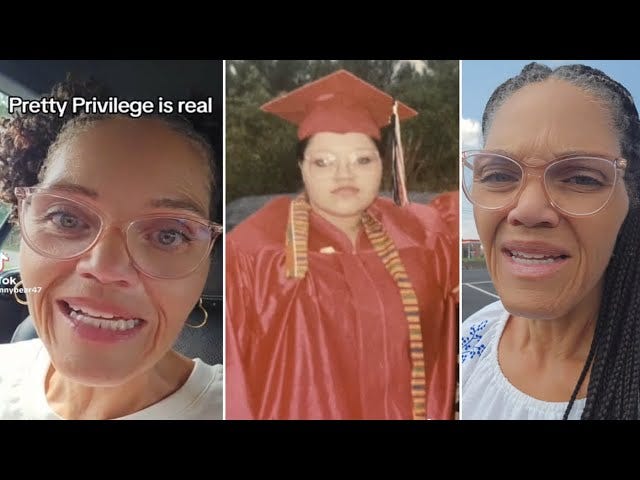
A few days ago, I came across a video of Tameka, a 50 year old, light-skinned, green-eyed, curly-haired biracial woman who dared to call herself pretty, while complaining that she has experienced jealousy from other women due to the male attention that comes with her perceived beauty. This video went viral.
Here we go.
I actually found Tameka’s video through a dark-skinned black female YouTuber who was sharing her thoughts about it.
The first thing this Youtuber did, was cut down this woman a few notches. She raised her eyebrows and said Tameka must have a lot of self-confidence to go on the internet and call herself pretty.
She talked about this woman’s age, how she looks older than she is, and how she used to be “cute” when she was younger, but she has never been “drop-dead gorgeous”. She gently placed her hand on her chest and politely proclaimed that she personally did not find Tameka to be attractive, but that is just her humble opinion.
When I researched Tameka’s video, I found a bunch of video responses like this, mostly from other dark-skinned women. In fact, the first Youtuber was tame in comparison to other responses. The few videos and comments I saw were of black women calling Tameka a yellow raisin; Saying she looks like a zombie from Michael Jackson thriller; comparing her to E.T.; Saying she’s delusional for thinking she’s beautiful, etc. etc.
It was a loud chorus of “OH YOU THINK YOU CUTE?!?!”
All of the responses amplified the same message:
You don’t have true beauty. The only reason why you’re perceived as beautiful is due to a legacy of racism.
It’s socially acceptable to bully Tameka because she’s the privileged one.
And, I have a bone to pick about this.
Last week I wrote an essay called, “Colorism is a Sign of Cultural Degeneracy” where I talked about how colorist relationships are a clear sign of regressive, uncritical thought within a population.
I also mentioned that I have been on both sides of the “pretty light skinned girl” equation.
As a brown-skinned, Afro-Diasporan woman of mixed heritage, I have written about being the “pretty, fair-skinned, mixed girl” in certain environments because of my complexion and features. Despite this, I have also felt my beauty undervalued in other environments for those same features, along with my kinky hair.
It’s very interesting how colorism plays out depending on what end of the spectrum you’re on, relative to who you’re surrounded by.
Either way, this gives me the unique advantage of seeing both sides of the coin.
So while I abhor colorism and don’t appreciate seeing dark skin devalued, I also have a great deal of compassion for “pretty” light-skinned women, because, in some contexts, I happen to be one of them.
And even in the times when I am not, my Mother, Grandmother, and Aunties certainly are.
…
The most pressing thing about the phenomenon with Tameka’s video, was the socially-sanctioned bullying.
Although colorism is a pervasive issue that affects people’s lives on a deeper structural level, there is a double standard amongst black women, when it comes to who is allowed to openly affirm their beauty and desirability.
If you’re not conventionally attractive, women will find it acceptable for you to celebrate your beauty, because you’re not perceived as an actual threat.
And regardless of what you look like, if you don’t think you’re attractive, women will be more willing to come to your rescue and hype you up if, for example, you cry about feeling ugly. Especially if you are dark skinned.
Everyone will be throwing pity compliments at you, telling you you’re gorgeous, just to make you feel better.
The moment you actually build confidence, someone will attempt to humble you.
But hey!
The girl’s girls got your back for now, SIS!!!
That said, if you are conventionally attractive in any way, and you celebrate your beauty, and you have the nerve to talk about the real life struggles you face with other women who are jealous of you—they’ll be coming out left and right with their pitchforks to gaslight and cut you down a few notches.
And if you happen to be mixed and light-skinned, your confidence will hit a particular nerve for many black women.
They will attempt to humble you with the idea that you’re not actually beautiful—you’re just perceived that way because we live in a racist society.
Or, if you are a mixed black woman whom darker black women look to for positive beauty representation in the media, it’s unacceptable for you to identify with your non-black heritage, or appreciate your mixed features.
Many black women will think you’re being uppity, and will try to redefine you in a way that allows them to claim you; often by over-emphasizing your blackness.
Either way, you’re not allowed to own your unique beauty.
You’re supposed to bow your head and sit your high-yellow ass down in a dark corner so that those who are less privileged than you can shine.
The amount of ageism and internalized misogyny that came out of the woodworks for Tameka’s video was insane.
These humbling tactics BLEED jealousy and insecurity.
I understand that not everyone who attacked Tameka necessarily wants to look exactly like her. But envy is not about wanting to be a carbon copy of someone else.
It’s about being resentful that someone else has something that you want for yourself, while also wishing that they could lose it.
If beauty is subjective, why can’t Tameka think she’s beautiful? Why can’t others find her beautiful?
Why is the perception of her beauty incorrect?
Personally, I do think that light eyes against tan or brown skin is pretty. It’s a rare human trait. Why can’t she acknowledge that feature as part of her beauty?
Me thinking that light eyes are pretty does not mean that I don’t also appreciate dark or African features…because I do.
Two things can be true at the same time.
We need to make way for that spectrum of perception, instead of shaming and punishing light-skinned women who love themselves.
I could understand people checking (not bullying) Tameka if she was saying that her features were superior to that of a dark-skinned woman.
But that’s not what she said.
This woman was called colorist for simply calling herself beautiful and being truthful about her experiences, while existing with light skin, green eyes, and curly hair.
Ending colorism is not about dark skin supremacy. It’s not about diminishing lighter-toned women’s beauty.
It’s about bringing balance back into public perception, so that light-skinned women can be equally appreciated alongside our darker-skinned sisters without any false hierarchies influencing how we are all perceived.