

Black Neighborhoods Are A Different Kind of Safe
For A Woman Like Me

It has been 3 weeks since I moved, and I’m feeling in my element.
Despite me shuttling myself around the world, this is the first time I am living in a black neighborhood, in America, in a little over 10 years. And, it really hits different.
No more white women smiling up in my face telling me I look like Medusa. Nope!
Every single day, whenever I go out, it’s a choir of “Hello, Gorgeous!” or “Wow, your locs are beautiful, how long have you been growing them?” Yesterday, a young Caribbean woman even told me my locs are Mermaid-like.
Swish-Swish!!!
The first day I moved in, I walked into my local grocery store just to see what they had to offer, and I literally almost cried. Fresh Okra was in the bulk produce section, as it if were a normal vegetable! And, there was a long aisle dedicated to African and Caribbean food items. Not a section; an aisle.
I’m talking Ogbono seeds, Palm Oil, Fufu, Dawadawa, Jamaican dumpling mix, Ackee, Chin-Chin…
Even Abacha—a hyper-local Igbo salad that I haven’t eaten since I was a teenager—a super traditional food I had long since forgotten about...was there.
Even post-colonial African snacks like Golden Morn cereal—was there.
It was all just there. Neatly stacked and organized between the other aisles that housed a variety of American products. I had never seen anything like it in my life.
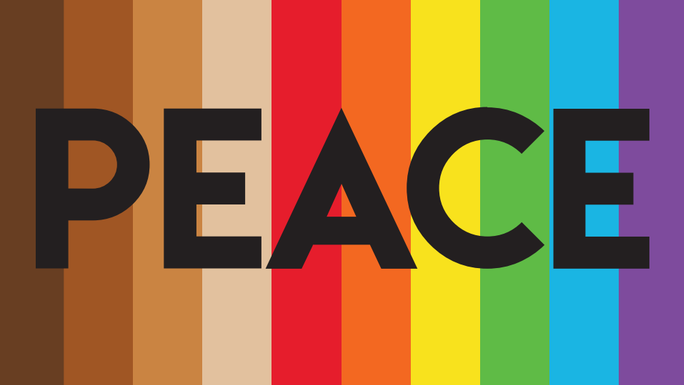
Before walking out of that store, I noticed that they had posted a huge rainbow flag with black, brown, and tan stripes to represent the hues of the people in this community.
Now, I don’t think businesses should feel obligated to put up any kind of gay pride flag. But I thought it was a nice gesture, and I loved that they chose this particular version of the flag, because it’s the only one that speaks to me, and it’s super rare to find it anywhere.
What I am experiencing is recognition.
Here, I feel a true sense of belonging, as if I’m part of something greater than just myself. In contrast to the isolation I have felt in white liberal communities, including the one I just came from—being in this neighborhood has been healing.
One of the things that strikes me is my feeling of safety.
Safety has been at the forefront of my mind for many reasons, but it has become more prominent as I’ve begun writing about gender ideology online.
Although my writing spans across several topics, the work I’ve published on gender ideology has been impactful, and there’s no way to separate those works from my other creations. I’ve been marked by my contributions on this topic, and my values arouse deep hostility from a very loud, politically influential minority.
This has changed the way I navigate the world, and especially community spaces. It has required new levels of discernment and care for myself, especially as I grow my presence.
Yes, my neighborhood has its problems. Like many black neighborhoods, its “danger” element is often exaggerated by people outside of the community.
But ironically, I feel much safer here than I did in an affluent white “queer” liberal area with much lower crime rates…It’s just a different kind of safe.
I just graduated from a 3.5-year stint of living in my white liberal hometown—a quirky place rich with lesbian history, newly gentrified into queer-trans central.
Unlike most white residents who moved to my hometown for the “utopian” vibe, I was the rare black bird who was lucky enough to have been born and raised there.
Although beautiful, my hometown was utterly suffocating. I have always tried to describe it in words, but the feeling was mostly energetic.
White liberal culture has frankensteined itself into a pressure valve, espousing a rigid, narrow-minded pomposity—couched under the guise of openness, freedom, equity, and safety for all.
Despite me ticking off many boxes of someone who should be intentionally included, I only ever felt that my warm welcome was skin-deep. That feeling was amplified when I began writing about controversial issues online. Even the sprinklings of “BIPOC” community spaces were unknowingly replicating the worst aspects of white liberal culture, leading me to feel isolated in places that advertised a true sense of belonging.
I was an anomaly; a minority both inside and out—and I felt that burden each day.